Family and descendants of
William Bodger and Elizabeth Ainsworth
(last updated: 21 October 2026)
 According to the 1911 census, William and Elizabeth had eleven children, only eight of whom were still living at the time. To date we have only been able to identify the eight surviving children as follows: Frederick Ainsworth Bodger (born in 1867 at Marylebone in London), Ada Elizabeth Bodger (1871, Stoke Newington Middlesex), William Ainsworth Bodger (1873, Stoke Newington), Hector Charles Bodger (1874, Stoke Newington), Francis Ainsworth Bodger (1877, Loughton Buckinghamshire), Arthur Joseph Bodger (1879, Loughton), Mabel Emily Bodger (1884, Leytonstone Essex) and Herbert Ainsworth Bodger (1888, Leytonstone).
As detailed below, only three of these eight married and provided William and Elizabeth with grandchildren. William and Elizabeth's eldest daughter, Ada Elizabeth Bodger (pictured on the left with her sister Mabel Bodger), also married - to William Joseph Parsons (1863-1944) in the West Ham Registration District of London in 1918 - but as far as we can determine had no children (click here to see a further photo of Ada with her husband and two brothers).
The UK National Probate Calendar shows that William Joseph Parsons of 8 Gainsborough Road Leytonstone in Essex, died on 21 December 1944. Probate went to his widow Ada Elizabeth who died at the same address on 15 January 1956. Probate from her will was paid to John Leslie Holl, a civil servant. Ancestry's database of 'UK and Ireland, Masters and Mates Certificates, 1850-1927' includes a John Leslie Holl, who was born at Leyton in 1905 and, in 1927, was granted, by London's Board of Trade, a certificate of competency as Second Mate of a Foreign-Going Steamship in the Merchant Service. We suspect Ada was a long-time friend of John's mother, Florence Julia Bailey, who was born at Leyton in around 1874 and married Edward John Holl there in 1897. The 1911 census shows Florence (then 37 and married), living at 9 Abbotts Park Road in Leyton with her son John (5) and three other children: Edward (12), Frank (10), and Millicent Holl (2).
According to Ian and Moina Bodger, William and Elizabeth's other daughter, Mabel Emily Bodger, never married. She lived with her parents until their respective deaths in 1905 and 1916, and was working as a clerk for a 'wholesale provisions merchant' in 1901, a typist in a book publishing firm in 1911, and an 'insurance officer' during the First World War. Some time after the war she moved to North End in Portsmouth in Hampshire where she lived the remainder of her life (the UK National Probate Calendar shows she died a spinster at 10 Amberley Road North End on 6 June 1963. Probate from her will went to the National Provisional Bank Limited which advertised for claimants in the London Gazette and other places).
The girls' brother, Arthur Joseph Bodger, lived much of his relatively short life at Leytonstone in Essex where he was working as a clerk for a 'spanish merchant' in 1901 and a shipping merchant in 1911. Although a foot deformity meant he avoided the perils of serving in Britain's armed forces during the First World War, he only survived wars' end by one year, dying at the University College Hospital in Middlesex in 1919 (probably from the Spanish flu epidemic that swept through Europe although that has still to be confirmed). The UK National Probate Calendar shows that at the time of his death he was living at 39 Herman Hill in Wanstead in Essex and probate from his last will and testament went to his brother, Frederick Ainsworth Bodger.
William Ainsworth Bodger (1872-1944)
Born at Stoke Newington in London on 30 April 1872, William was living with his family in Leytonstone (on Clearwater lane) in Essex at the time of the 1891 census. The 1901 and 1911 censuses have him still at Leytonstone and working as a carriage builder in 1901 and a wheelwright for the Great Eastern Railways in 1911. David Sowerby, a military historian who has researched and written about the Essex Volunteer and Territorial Artillery, tells us that during this time William joined the 10th (Stratford) Company of the Essex Artillery Volunteers thereby beginning a long and ultimately distinguished military career. In 1893, the then Gunner Bodger 'was selected to be part of the team that went up to Shoeburyness to take part in the National Artillery Association competition, the
premier event in the Volunteer Artillery calendar . . . his team, No. 6 detachment
[pictured below] did not disappoint . . . taking the top honour, the "Queen's Prize",
[and] receiving prize badges for their arm, and a silver cup each'.
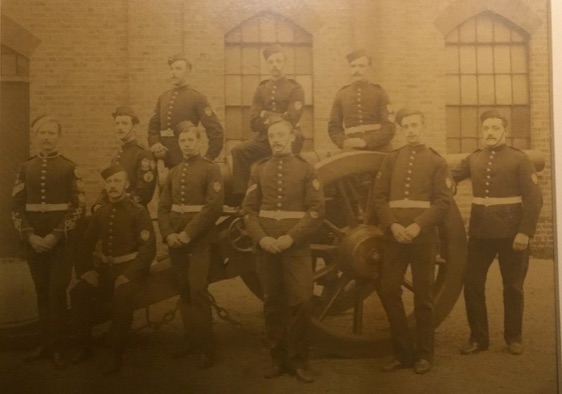
No 6 Detachment with Gunner William Ainsworth Bodger fourth from the right in the front row.
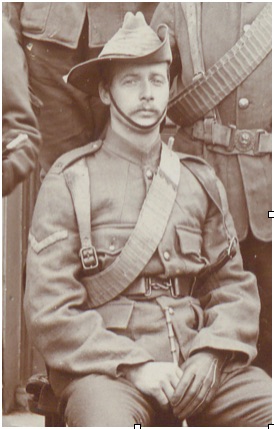 David adds that in 1899, the by then Sergeant William Bodger 'was chosen as one of the "lucky few" to be a part of the City Imperial Volunteers and their "Great Adventure" in South Africa' (in order to be a part of the C.I.V., William 'had to accept a temporary reduction in rank to lance corporal'). The brainchild of London's then Lord Mayor, the C.I.V. 'caused a major splash in the country at the time; a truly combined force of Infantry, Mounted Infantry and a Battery of 12-inch Guns manned by the Honourable Artillery Company. The C.I.V. were feted throughout London, leaving for South Africa amidst a blaze of publicity and crowds in January 1900'. After receiving a raptuous reception on their arrival in Capetown in South Africa a week or so later, William and his C.I.V. colleagues were soon in action including in the Battle of Diamond Hill where alongside the Coldstream Guards they 'pushed Boer Commandant-General of the Transvaal, Louis Botha, away from his march on Pretoria' (an outcome seen by some commentators as 'the turning point in the War').
By October 1900 William Ð now a full Corporal Ð and the C.I.V. had set sail for home . . . [where] the returning soldiers found themselves mobbed by well-wishers from the moment they docked in Southampton. Taking the train to Paddington the C.I.V. then parade marched through the streets from Paddington to St. Paul's Cathedral and then on to the Guildhall and a reception at Temple Bar given by the Lord Mayor and Sheriffs. The crowds were such that 22,000 troops were required to line the streets that the Volunteers were passing through.
For his service in South Africa, William - pictured on the right - received the Queen's
South Africa Medal with bars Cape Colony, Orange Free State, Johannesburg and Diamond Hill. David Sowerby tells us that 'soon after his return William regained his three stripes and re-joined the 10th Company of the Essex Artillery Volunteers in Stratford'. He adds that William 'stayed with No.10 Company throughout the rest of the lifetime of the Volunteers; transferring to the new Territorial Force in 1908 with the rank of Wheeler Quartermaster Sergeant of the 1st Essex Battery, 2nd East Anglian Brigade R.F.A'. At the onset of the First World War, the 2nd East Anglian Brigade (later named the 271st Brigade) became the divisional artillery of the 54th (East Anglian) Division. While the rest of the Division was sent to serve in the Dardanelles in 1915, William's artillery brigade underwent active service in Flanders in France and, after that, in the Middle East with the UK's Egyptian Expeditionary Force.
David tells us 'William finished the war as a temporary Warrant Officer Class 1 and
received a 1914-15 Star, British War Medal and Victory Medal for his service. He also received a further long service medal, in the form of the Territorial Force Efficiency Medal, promulgated in Army Order 369 in 1920'. David adds that, unlike many of his colleagues, William then re-attested for the new Territorial Army. 'Assigned the new number of 723210, he carried on serving until his final retirement on 22 March 1924, in the rank of Warrant Officer Class II (Q.M.S.)' - see the photo of William with his two bothers below. After leaving the Army, William resumed working as a wheelwright/engineer with the Great Eastern Railway. As the photo immediately below shows, he also remained in close contact with his old military comrades.
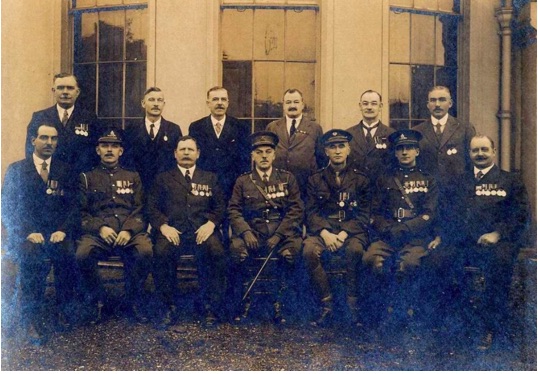
William Ainsworth Bodger, seated on the right, with some of his former Essex Artillery colleagues in 1927.
The 1939 England and Wales register shows William A. Bodger, single and a retired
railway worker who was born on 30 April 1872, was living at 142 Gainsborough road in Leytonstone with his sister, Ada E. Parsons (born on 12 May 1870) and her husband, William J. Parsons (a retired Gas Company official who was born on 21 Feb 1865). The Catherine House Index shows that a William A. Bodger, who was born in 1872, died in Essex in 1944 (4a, 195). The London Cemetery and Crematorium Burial registers, 1856-1998 tell us he was buried in the Little Ilford Cemetery in London on 8 July 1944. We don't believe William married or had children.
Frederick Ainsworth Bodger (1866-1927)

 Born at Marylebone in London, Fred (pictured on the left) was living with his parents at Leytonstone at the time of the 1901 census. Brian Freer has told us that Fred was best man to Brian's wife's great grandfather, James Thomas Benjamin (who married Emily Sophia Pearman in London in April 1905). He adds that both Fred and Jim worked as clerks in the same business and Fred gave Jim a gold signet ring to mark the occasion. Jim, in turn, named his first son Ernest Ainsworth Benjamin (who was born at Brixton in London in 1907). 'Up until now', Brian continued, 'we had never been able to work out where the Ainsworth came from, we have always been looking for a family link rather than a friend...we can now safely assume it is from the Ainsworths of Graffham'. Fred's close links with his workmates extended beyond Jim Benjamin. The 1911 census shows Fred, 44 single and working as an assistant secretary to a London publisher, as a visitor to the home of Charles Henry and Lydia Mary Young and their five children at 53 Studley Road in Clapham. Charles Young (49) was a builder but three of his children - William Charles Hamilton Young (20), Elsie Mabel Young (18) and Eric Tyrrell Young (16) - worked as clerks for the same London publisher as Fred.
We know from a letter written to his cousin Amy Chibnall in Australia in 1916, and supplied to us by Helen Bretherton, that Fred was then living in an artists' quarter in Chelsea in London. Although he worked as a publisher's clerk, Fred informs his 'dear cousin' that he 'puts in a good deal' of his spare time painting. 'I have just returned from my holiday ... [where] I have done a little sketching in Huntingdon and Bedfordshire. They are pretty counties. I passed the cottage the other day where my father and your mother were born, it is still in good repair but empty, the old lady who had it for some years has recently died'. We think Fred belonged to either the Chelsea Club or the Chelsea Arts Club. According to its website, the latter was established in 1890 and 'began life as a grass roots initiative by working artists in the late nineteenth century. The Club was from the outset deliberately bohemian in character, seeing itself outside the normal definition of the 'establishment', in contrast to various other clubs, artistic and non-artistic, in London'. According to James Brazier, it 'was - and still is - a club for professional artists whereas, I suspect, the Chelsea Club was an everyman's club with a number of amateur artists amongst its membership'. As such he thinks it more likely Fred belonged to the Chelsea Club and, in support of this view, has provided us with a photo - shown on the right - of a Chelsea Club war memorial honouring those of its members who either served or were killed in the Great War. The memorial was painted by none other than Frederick Ainsworth Bodger.
In his letter to his Australian cousin Fred added that 'at the moment of writing my brother Will is in Egypt while Hector who was in the Navy has served his time some years ago and is married with five children. Frank is a recruiting serjt [sic] at Bath and Bert is, as you know at Salisbury. Arthur has been refused the Army on account of a deformed foot and I, the eldest am too old, so that sums us all up with the exception of the two girls who are in business. Ada is in the War Office and Mabel is an Insurance Officer'. Fred continues with the observation: 'We are not a marrying family I'm afraid, there are only two out of the eight married, that is Frank and Hector, but they have eight children between them'. True to his word, Fred never married but remained close to his family all his life, receiving probate from his father, William Bodger, in 1916 and younger brother Arthur Joseph Bodger in November 1919. The Catherine House Index shows that Fred died at Chelsea in London in 1927 when he was 61 years old. He seems not to have left a will.
Hector Charles Bodger (1874-1919)
Ancestry's London births database shows that Hector was born at Stoke Newington on 15 June 1874 and baptised there on 16 August the same year. His parents were then living at 'Dalston' and William was working as a policeman. Hector joined the Royal Navy sometime before 1891. In 1901 he was an able seaman serving on HMS GEDA at 'Southampton Water off Netley' in Hampshire. In 1909 he married Florence Beatrice Fountain (1889-1979) at the West Ham registration office in London. Born in London, Florence was the daughter of Edwin Fountain and Emma de Rose. The 1911 census shows Hector Charles (a 36 year-old 'Auto Gas Collector' who was working for the Gas Light and Coke Company) and Florence Beatrice Bodger (21, Victoria Park London) living at 32 Percy Street in Leytonstone. With them were their two children William Ernest (1) and Florence May Bodger (7m) both of whom had been born at Leytonstone.
Hector died at Leytonstone in 1919. By then he and Florence had seven children: William Ernest Bodger (born in 1909), Florence May Bodger (1910-2002), Hector Arthur ('Buster') Bodger (1912-41), Elizabeth Ainsworth Bodger (1913), Mabel Emily Bodger (1916-92), Ada Rosemary Bodger (1919-2005) and Hilda Bodger (1921). One of Florence's descendants now living in South Africa, Suzi Homans, tells us that following Hector Charles' death in 1919, Florence married Albert Ernest Cooper (Suzi's grandfather). She then became known to the family as 'Nanny Cooper'. She died at Oldchurch Hospital in Romford in Essex in 1979, aged 89 years.
What of their children? We know nothing of Hector's oldest son, William Frederick Bodger, beyond his date and place of birth. Their eldest daughter, Florence May Bodger married Robert William Evans (1906-88), the Welsh-born son of William Samuel and Ada Georgina Evans, in the Shoreditch Registration District of Middlesex in 1937. They had two children, Colin Anthony and Noel David Evans, in England before emigrating to Australia in the late 1950s or early 1960s. The Australian electoral rolls show Robert William, a public servant, and Florence May Evans living at 7 Acacia Street in Geelong North in 1963 (along with a Colin Anthony Evans, instrument mechanic) and 1968 (along with a Colin Anthony Evans, instrument mechanic, and Noel David Evans, teacher). Only Robert and Florence were there in 1972 and 1977. Robert died in Geelong in 1988. According to the 'Evans Family Tree' on Ancestry.com, Florence died at Beechworth in central Victoria in 2002.
The records of the Commonwealth War Graves Commission show that Hector Arthur ('Buster') Bodger was killed while on duty as a civilian fire watcher at Leytonstone on 11 May 1941. He was 29 years old and had been married, to Sylvia A. Hall in the previous year (the Catherine House Index shows that Sylvia re-married in 1946, to Thomas J. Wadner in the Essex South Western RD of Essex). Another of Hector and Florence's descendants, Doreen Reeve, tells us that Elizabeth Ainsworth Bodger married Sidney Cazaubon in 1939 and had three children: Sheila, Norma and Martin Cazaubon. The census and other sources maintained by Ancestry.com show that Sidney Leonard Cazaubon was born at Plaistow in Essex in 1907, the son of Joseph Arnold Cazaubon and Louise Ann Kelly, and died in the Havering Registration District of Essex in 1988.
Doreen Reeve has also told us that Mabel Emily Bodger married George Arthur Barker (1915-87) in Ilford in Essex in 1940 and had at least two children: Robin George and Michael John Barker. Mabel died in the Brentwood Registration District of Essex in 1992. Dorren continues that her mother, Mabel's younger sister Ada Rosemary Bodger, married Walter James Stepton (1920-89) at Barking in Essex in 1941 and had six children in addition to Doreen: Alan, Patricia, Peter, Janet, Brenda and Anthony Stepton. Ada died at Goodmayes in Essex in 2005. her husband had died at Romford sixteen years earlier. Hector and Florence's youngest daughter, Hilda Bodger, was born at Forest Gate in London in 1921 and married Walter Frederick Carvell in the Ilford registration District of Essex in 1947. One of Hilda's grandsons, Simon Burton, tells us that Hilda and Walter had three children: Denise Elizabeth (1952-2002), Lynda, who married Brian Affleck, and Lance Carvell 'who has lived in Germany since the late 1970s and has two children.' He adds that his grandmother Hilda, with whom he shares a birthday, lives in Billericay in Essex. She 'often talks of her brother, Buster, who was killed during an air raid (WWII). She also had another brother known as Bert Cooper born around the 1920s'.
Hector Charles Bodger and his wife Florence Beatrice Fountain
Francis Ainsworth Bodger (1876-1940)
 Francis was born at Loughton in Buckinghamshire. His record in the UK National Archives shows that he enlisted in the Royal Marine Artillery in London on 20 April 1894. He was then working as a clerk and described his religious faith as Wesleyan. He was promoted to corporal in 1895, sergeant in 1898 and colour sergeant in 1912 (the photo on the left shows Francis in his colour sergeant's uniform). During this period he served on a number of Royal Marine ships including the 'Rupert', 'Renown', 'Goliath', 'Queen' and 'Africa'. The 1911 census shows Francis, a sergeant in the Royal Marine Artillery, at the home of his widowed father, William Bodger, at Leytonstone in Essex. The census return informs us that he had been married three years and had two children.
Francis' wife was Elizabeth Caroline Lovell (1889-1977) who he married at Portsmouth in Hampshire in 1907. A native of the town, Elizabeth was the daughter of Charles Vincent Lovell and Caroline Angell who were married in the Winchester RD of Hampshire in 1874. The 1901 census has the twelve year-old Elizabeth living at Portsmouth with her parents Charles (a 53 year-old labourer born at Weymouth in Dorset) and Caroline Lovell (46, Sutton Scotney Hampshire) and three siblings: Frank (19), Daisey (16) and Ernest G. Lovell (8) all of whom had been born at Portsmouth. The 1911 census has Elizabeth, 22 and married, living at 5 Ringwood Road Eastrey in Portsmouth with her and Francis' first two children: Dorothy Mabel (2, Portsmouth) and Hilda Bodger (8m, Portsmouth).
The onset of the First World War saw Francis mobilised for active service in 1915. We think that he served for a time in France before being appointed as a recruiting sergeant at Bath in the county of Somerset. He and his family continued to live at Bath after he was demobilised from the Army in January 1920. They became the owners and proprietors of the Marlborough Hotel there and were well known in the town. The Catherine House Index shows that Francis died at Bath in 1940 (probate from his will went to his widow, Elizabeth Caroline Bodger). Elizabeth died there in 1977.
Francis and Elizabeth Bodger had four children we are aware of:
1) Dorothy Mabel Bodger (1908-71) who married William Charles Gillard (1789-1975) at Bath in 1944;
2) Hilda Bodger (1910-73);
3) Arthur Bodger (1912-79) who married Freda Sykes at Salisbury in Wiltshire in 1942 and had at least one child: Maureen Bodger who we think married Edward Lyness at Salisbury in 1962;
and
4) Francis A. B. ('Frank') Bodger (1928-2012) who married Elsie Mary Angell (1925-86) at Bath in 1967 (while still to be confirmed, we suspect that Elsie may have been earlier married to a William Angell who had married Elsie M. Cooper in the West Bromich RD of Staffordshire in 1943). After his death in 2012, the Bath Chronicle published the following article on Frank Bodger:
A dedicated volunteer at the Royal National Hospital for Rheumatic Diseases [known colloquially as the 'Min'] has died at the age of 82. Frank Bodger who lived in the city centre, was the vice-chair of the hospital's official friends group...Mr Bodger spent his early years in Camden Crescent, and worked in the pub trade. His parents owned the Marlborough Tavern and he worked there for many years, and he also ran the Huntsman...Along with his wife Elsie, he started to volunteer at the Min, and joined the Friends. The couple had no children, and spent much of their spare time working at the hospital. After Elsie's death in 1886, Mr Bodger, who by then was retired, spent more time at the hospital, visiting every day to volunteer, and eating lunch in the canteen. His duties included watering the plants, taking magazines to the patients and putting together a welcome pack for patients...As well as his work with the Friends, Mr Bodger was a keen gardener, and a regular winner in the Bath in Bloom contest...He only had a small patio but that was filled with lots of brightly coloured flowers...A keen ballroom dancer, he also took part in the dance lessons every Wednesday at the Min.
Herbert Ainsworth Bodger (1888-1940)
William and Elizabeth's youngest son Herbert Ainsworth ('Bert') Bodger was born at Leytonstone in Essex in 1888 and grew up there as a boy. In 1905 he commenced work with a publishing firm, George Newnes Ltd of London before, in around 1910, emigrating to Australia where he took up farming at Gin Gin near Bundaberg in Queensland. The records of the Australian War Memorial show that he enlisted in the Ist AIF in Brisbane in Queensland on 8 November 1915. His enlistment papers state he was born at London and had previously served three years in the Essex Yeomanry. Bert gave as his NOK his brother Arthur Joseph Bodger who was then living at 77 Tillebrook Road in Leytonstone.
Bert was assigned to B Company of the 42nd Infantry Battalion which would serve in the 11th Brigade of the 3rd Australian Division. He embarked from Sydney on the HMAT BORDA on 5 June 1916 and, after training in England where he was promoted to corporal, proceeded to France with his battalion in November 1916. After participating in the battle of Messines near Ypres in Belgium in June 1917 he was promoted to sergeant and posted back to England for a stint with the 11th Training Battalion at Tidworth. In December he returned to his battalion in France where he would have participated in the battles of Amiens and Hamel. He was gassed in June 1918 but continued to serve with the battalion until it was disbanded in September 1918. He was then transferred to the 41st Battalion with which he remained until his return to Australia on 12 June 1919.

Three of the Bodger brothers either during or just after World War I (from L/R):
William Ainsworth, Francis Ainsworth and Herbert ('Bert') Ainsworth Bodger.
His son, Ian Bodger, tells us that after he returned from the war Bert worked for a time as a clerk in the Brisbane Soap Company before moving to the Stanthorpe area where he worked until August 1920. In 1922 he signed an agreement with the British Administrator of former German New Guinea to be employed in Rabaul as a Plantation Overseer for the salary of £300 per annum. His military record reveals that while 'engaged in the Expropriation Board in Rabaul in 1922-23', Bert had his First World War medals and a number of other items stolen from his residence and sought, successfully, to obtain a replacement set of medals. In 1925 he was transferred to Madang and then Kaewieng in New Guinea. Ian goes on to say that the 'discovery of gold at Edie Creek above Wau in 1926 sparked off a gold rush of massive proportions, which led to the development of Salamaua as capital of the Morobe District'. Bert joined the Ellyou Goldfields Development Company in April 1929. 'By this time there were about 200 miners and three tons of gold being removed each year'. He was sent to take charge of the company's Salamaua office. Six months later Ellyou was taken over by New Guinea Goldfields Ltd and Bert, who was reappointed by the new company as its district secretary, was transferred to Edie Creek.
 It was here that Bert met and married his wife Edith Maud Bennett. Edith or 'Edie' was born at Hillgrove in New South Wales in 1907. Her parents were Henry Bennett and Maud Florence Newbury who were married at Cobar in New South Wales in 1898 and, according to the 'My Family Tree' on Ancestry, had four children in addition to Edith: Grace Marguerite, Henry Newbury, Victor Edwin and Benjamin C. Bennett. Henry and Maud and their family lived the latter part of their lives at Tamworth, she dying there in 1941 and he in 1946.
After attending school at Thirroul and Wollongong, Edie worked as a clerk for the Sydney-based Electric Light & Power Supply Corporation. Early in 1930 she threw in her job and travelled by ship to New Guinea with the Newberry family. 'Mr Newberry was employed by New Guinea Gold as an engineer' and Edie worked as his childrens' governess. After their marriage on 22 August 1931, Edie travelled with Bert to England for their honeymoon and met up with members of his family. Click here to see a photo of Bert with his brother Will and sister Ada). Shipping documents collected by Irene Restall show that Bert and Edie returned from England to Australia on the Hobson's Bay which was owned by the Aberdeen and Commonwealth Steamship Line and sailed from Southampton on 20 July 1932. Their last address in England had been '8 Gainsburo Road E 11' (the address of Bert's sister at Leytonstone) and they were to disembark at Sydney.
Together with their son Ian, the couple lived at Edie Creek until 1938 when Bert was transferred to Wau to be Secretary to the General Manager of New Guinea Goldfields. 'On 25 August 1935 he was [also] appointed as a Commissioner of the local Supreme Court for which he took affidavits'. In December 1939 ill-health forced Herbert to resign his position and return to Australia. 'Ian and Edith remained in New Guinea until news came through that Herbert was terminally ill. They returned to Australia on the passenger boat NEPTUNA (which was sunk in Darwin harbour during the Second World War)'.
Bert and Edie and Ian lived with Edie's sister Grace and brother-in-law Rev. G. A. Baker at West Tamworth until Bert's death there in August 1940. His death certificate shows he died of cancer of the bladder and was survived by his wife and only son, Ian Ainsworth Bodger, who had been born in Carlton in Sydney in 1933. Edith and Ian continued to live in Tamworth after Bert's death. Aware she would eventually have to support herself and Ian, Edie had enrolled in a Business College to gain more credentials for employment. This enabled her initially to work as a book keeper at Goonoo Goonoo Station - a large grazing company approximately twenty miles from the town - and then in Tamworth itself, first with Fielders Flour Mill and then Keech's Amalgamated. She retired in 1967 and continued to live in Tamworth until her death there in 1976. Ian was apprenticed to the Tamworth City Council as an electrical mechanic in 1948, and married Moina Joyce Barber (1931-2010) in Tamworth in 1954. Ian and Moina had two sons, one of whom died in 1988.
Click here to return to the Bodger family, and
here to see more photos of the family of William and Elizabeth Bodger nee Ainsworth.
Image Sources:
Frederick Bodger courtesy of Helen Bretherton.
Ada and Mabel Bodger, Hector Bodger and Florence Cooper (formerly Bodger nee Fountain), courtesy of Doreen Reeve.
All other photos courtesy of Ian and Moina Bodger.


